OpenAI has introduced Businesses in ChatGPT, a new service that allows eligible companies to claim and manage their business information within ChatGPT. For UK businesses, this could become an important addition to their online presence, although not every feature is available here yet.
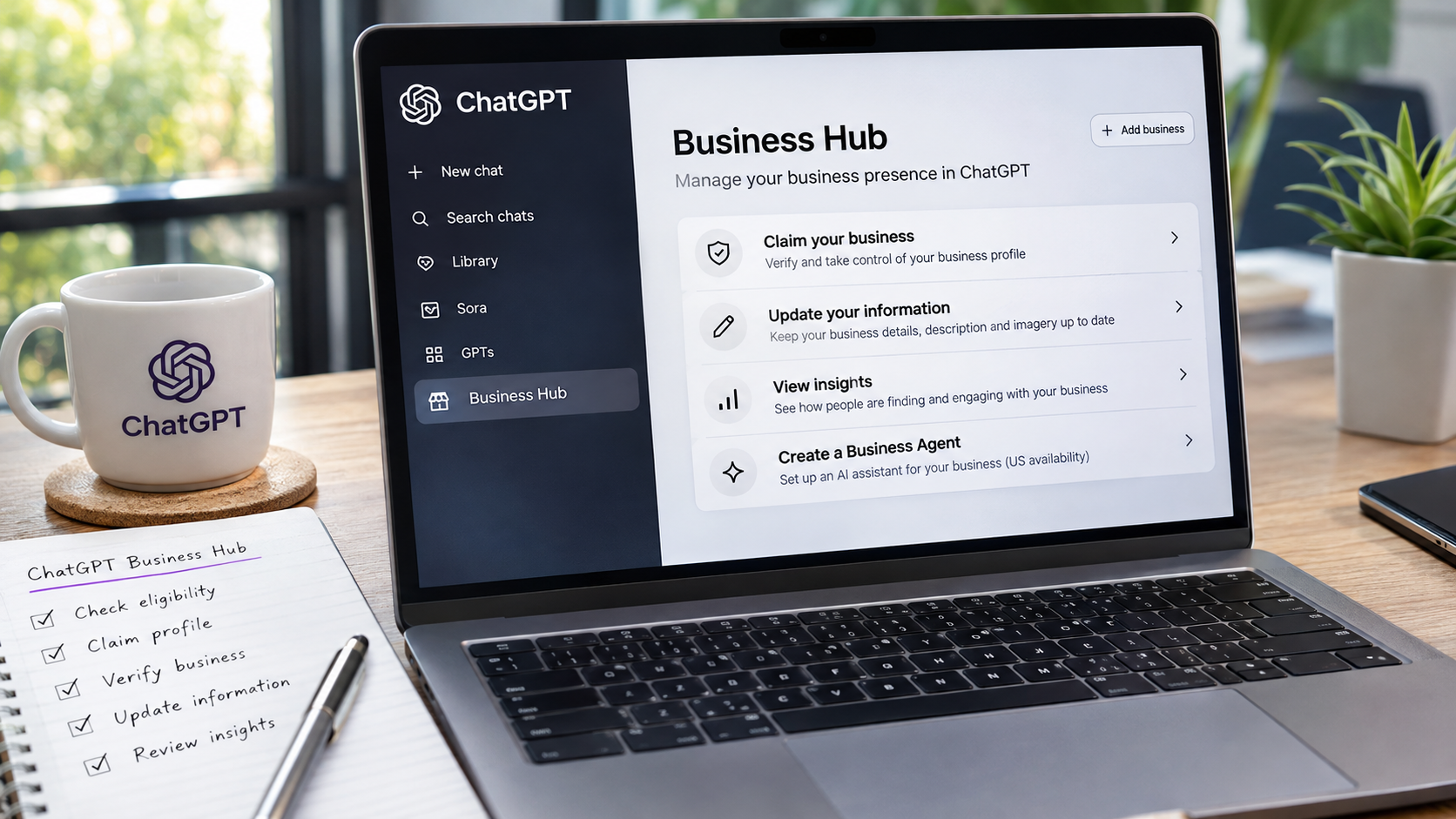
On 10 November 2026, OpenAI officially announced Businesses in ChatGPT, introducing a new management platform called Business Hub.
The service gives eligible businesses a way to claim their profiles, provide accurate information about their products and services, and understand more about how people encounter them through ChatGPT.
OpenAI also introduced Business Agents, AI-powered assistants that businesses can configure to answer customer questions directly within ChatGPT.
It’s an interesting development for companies already investing in search engine optimisation (SEO), local search and online visibility.
Until now, businesses have had limited direct control over how ChatGPT presents their information. Business Hub begins to change that.
However, there are important differences between what OpenAI has launched, what UK businesses can currently access and what remains restricted to the United States.
Here’s what business owners need to know.
What Is Businesses in ChatGPT?
Businesses in ChatGPT is a new OpenAI service designed to help companies manage information about their organisation and understand how people interact with them through ChatGPT.
The service is accessed through Business Hub, a dedicated management area within ChatGPT.
Depending on eligibility and verification, businesses can use it to:
- Claim an existing business profile or, where supported, create a new one.
- Verify that they own or are authorised to represent the business.
- Update details such as their website, business description and category.
- Add a logo, cover photograph and other supported business information.
- Provide product feeds containing prices and availability.
- Access aggregated information about business mentions and website clicks.
- Give employees or authorised agencies access to manage the business.
- Create a Business Agent where that additional functionality is available.
The intention is to give businesses a more direct way to provide accurate information that ChatGPT may use when answering customer questions.
That last point is important.
A verified profile does not mean ChatGPT will automatically recommend the business, prioritise it over competitors or use every detail the business provides.
OpenAI has explicitly stated that claiming a business does not guarantee higher placement, increased visibility or sales.
How is this different from ChatGPT Business?
Despite the similar names, Business Hub and ChatGPT Business are different products.
ChatGPT Business is a subscription-based workspace designed for teams using ChatGPT in their day-to-day work.
Business Hub is concerned with how a company is represented within ChatGPT and how it manages supported business information.
You do not need a ChatGPT Business or Enterprise subscription simply to apply to claim an eligible business.
Is Businesses in ChatGPT Available in the UK?
This is probably the most important question for UK business owners.
UK businesses are not automatically excluded from Business Hub, but eligibility and access depend on the type of business, its location and OpenAI’s verification requirements.
OpenAI states that eligible businesses in countries where ChatGPT is available can apply to claim their organisation.
However, its official eligibility and setup guidance places additional restrictions on particular types of business.
UK online businesses and service providers
Eligible online businesses may be able to claim an existing profile or add a business where the required functionality and verification are supported.
For example, a UK consultancy, digital agency or ecommerce company may be eligible to begin the claiming process.
Having a website is currently an important eligibility requirement.
However, that does not mean every UK business will receive immediate approval or access to every Business Hub feature.
UK local shops, restaurants and location-based businesses
There is a significant restriction in OpenAI’s current guidance.
Local stores and restaurants can initially claim only an existing US listing.
This means UK high-street businesses should not assume that the same claiming functionality is already available to them.
The specific restriction applies to the categories described in OpenAI’s guidance. It does not establish that every other type of UK local-service business is automatically eligible.
For businesses serving particular towns or regions, the distinction between online business profiles and physical business locations will be important as the service develops.
Our initial experience at Progress Digital
At Progress Digital, we’ve already started exploring the new Business Hub.
During our initial checks, ChatGPT located business profiles for both Progress Digital and Progress International.
However, selecting the claiming option did not immediately provide full access to manage those profiles.
Instead, we were placed on a waiting list.
This illustrates an important distinction between finding a business within ChatGPT and having an approved, fully manageable profile.
We’ll continue monitoring the process and OpenAI’s official announcements as access develops.
UK vs US: Which Business Hub Features Are Available?
The initial launch is not identical across markets.
The main differences, as of 11 November 2026, are outlined below.
Business claiming
UK: Eligible businesses can potentially apply to claim a profile where their business category and verification method are supported. Local stores and restaurants are subject to the current US-listing restriction.
US: Eligible businesses can apply to claim their profiles, including existing US listings for supported local stores and restaurants.
Business information management
UK: Available to eligible businesses following claim approval and the necessary identity verification.
US: Available under the equivalent approval and verification requirements.
Business insights
UK: Eligible, fully verified businesses can access supported reporting, including mentions, website clicks and discovery topics.
US: The same reporting capability is available to eligible, fully verified businesses.
Product feeds
UK: Eligible businesses can connect supported product feeds, including Shopify and compatible CSV feeds, subject to access and verification requirements.
US: Eligible businesses have access to supported product feed functionality.
Business Agents
UK: Not currently available as part of the general launch.
US: Available to eligible ecommerce and online service businesses that meet OpenAI’s additional requirements.
What happens next?
OpenAI has confirmed that it intends to expand Businesses in ChatGPT and Business Agents into additional markets and business categories.
However, there is no confirmed UK launch date for Business Agents, and OpenAI has not guaranteed that every feature initially offered in the US will be introduced here.
How to Claim Your Business in ChatGPT
For businesses eligible to start the process, the first step is to access Business Hub.
Visit ChatGPT Business Hub or use the claiming option on OpenAI’s official website.
Step 1: Find your business
Sign in to ChatGPT and open Business Hub.
Search for your business by name and select the listing that accurately represents your organisation.
Check carefully if several companies have similar names.
If no suitable listing appears, some eligible online businesses may be offered an option to create a new profile.
Step 2: Begin the claiming process
Confirm which ChatGPT account will be responsible for managing the business.
OpenAI may offer several methods for demonstrating your connection to the organisation.
These include:
- Business telephone: Receive a verification code by text message or automated call.
- Business email: Receive a verification code at an email address associated with the company.
- Website domain: Add a specified TXT record to the domain’s DNS settings.
- Shopify: Connect an eligible Shopify store to verify your relationship with the business.
Not every method will necessarily be available to every applicant.
If another company manages your website hosting or domain settings, you may need its assistance with DNS verification.
Step 3: Wait for OpenAI to review your claim
Submitting a claim does not mean it has automatically been approved.
OpenAI reviews claims and may contact applicants by email to confirm its decision or request additional information.
Some businesses may encounter a waiting-list process instead of immediate access.
If your business has already been claimed by someone else, OpenAI also provides an ownership-dispute process.
Step 4: Complete identity verification
This is an important additional stage.
OpenAI distinguishes between claiming a business and completing identity verification through Persona, its third-party verification provider.
Even after a claim is approved, further verification is required before a business can publish profile changes, access insights or create an eligible Business Agent.
Applicants may be asked to provide identification, business registration information and evidence that they are authorised to act for the organisation.
The blue verification check on a business profile appears after the required Persona verification has been approved.
Simply joining a waiting list or submitting an initial claim is not sufficient.
Step 5: Review and update your business information
Once the necessary approvals are in place, the business can access the relevant management features.
These may include updating its description, website, category, logo and other supported information.
OpenAI reviews submitted changes, and updates may take time to appear within ChatGPT.
Businesses should therefore regard their profile as an ongoing source of information that needs maintaining rather than something completed once and forgotten.
What Information Can Businesses Control?
Business Hub introduces the ability to submit and update key information about a business.
This can include:
- Business description.
- Website address.
- Product or service category.
- Company logo and cover photography.
- Additional supported business details.
- Product information, including pricing and availability where supported.
- Delivery and returns information for relevant retailers.
The precise fields available may depend on the business and its eligibility.
There is also an important limitation.
OpenAI’s Businesses in ChatGPT policy makes clear that businesses must supply accurate information and be authorised to manage the profiles they claim.
However, claiming a profile does not give a company exclusive control over everything ChatGPT displays about it.
ChatGPT may continue to use information from websites and other publicly available sources.
OpenAI can also review information submitted through Business Hub before publishing it.
This is why maintaining an accurate business profile is helpful but does not replace the need for a clear, informative website and consistent information elsewhere online.
Business Insights: Can You See How Often ChatGPT Recommends You?
One of the most interesting developments is Business Hub’s reporting capability.
Previously, it has been difficult for many businesses to establish how frequently their organisation appears in ChatGPT responses.
Traditional website analytics can help identify traffic originating from ChatGPT, but they generally cannot tell you how often the business appeared in an answer that did not result in a website visit.
Business Hub begins to address part of that gap.
Once the required verification is approved, eligible businesses can access aggregated reporting covering the previous 28 days.
Business mentions
Business Hub provides information about how often a business is referenced in qualifying ChatGPT responses.
However, the definition of a mention is important.
For an online business, OpenAI counts a mention when ChatGPT references its website. Simply including the brand name in an answer does not necessarily count.
For a local business, a mention can be recorded when ChatGPT displays a result for that location, even if the person does not open the listing.
This means the metric should not be interpreted as a complete record of every time a business name has appeared within ChatGPT.
Website clicks
Business Hub can also report how frequently people click through to a business’s website from qualifying ChatGPT interactions.
This provides another potentially useful indication of customer engagement.
It should be considered alongside existing website analytics rather than assumed to be identical to Google Analytics sessions or enquiries.
Discovery topics
Discovery topics group common themes associated with ChatGPT answers in which a business appeared or was cited.
For example, an insurance broker might discover that its website is being referenced in discussions about particular insurance products.
A renewable energy company might identify themes around solar panels or battery storage.
These insights could help businesses understand which subjects are associated with their online presence.
However, discovery topics are aggregated. They do not reveal individual customer questions or directly measure purchase intent.
Important reporting limitations
OpenAI has designed these insights to protect user privacy.
Businesses do not receive access to individual conversations or customer prompts, including conversations with Business Agents.
Reporting is also subject to activity thresholds.
A blank metric does not necessarily mean that a business received no mentions or interactions.
At Progress Digital, we would treat these insights as an additional source of information alongside Google Analytics 4, Google Search Console and existing search performance reporting.
As we’ve discussed in our article Google, Social Media or AI: Where Are Your Customers Actually Finding You?, customers can encounter a business through several different channels before deciding to make contact.
Understanding those interactions is useful, but measuring actual enquiries and business outcomes remains important.
What Are ChatGPT Business Agents?
Business Agents are another significant part of OpenAI’s announcement.
However, they are not currently available to UK businesses as part of the general launch.
Initially, they are available to eligible ecommerce and online service businesses in the United States.
A Business Agent is an AI-powered assistant that represents a particular business within ChatGPT.
Imagine someone researching a product.
They ask ChatGPT for recommendations, discover a suitable business and then choose to open a conversation with that company’s Business Agent.
They could ask questions about:
- Product features and specifications.
- Differences between available options.
- Pricing and availability.
- Delivery or returns policies.
- Which products might suit their requirements.
The agent can respond using information supplied or configured by the business.
Businesses can establish guidelines for how their agent communicates, review its information and test its responses before publishing.
The Business Agent conversation is clearly identified as representing the business and operates separately from ChatGPT’s independent answers.
OpenAI’s Business Agents policy explains the requirements businesses must follow when creating and managing these assistants.
Can Business Agents take orders or make bookings?
Not through the current Business Hub agent experience.
OpenAI’s initial functionality allows Business Agents to explain products and policies and direct customers to the business’s website.
They do not currently complete purchases, make bookings or retrieve individual customer orders through this experience.
This is worth understanding because the term agent can suggest a greater level of automation than the initial service provides.
Why could Business Agents matter to UK businesses?
If OpenAI introduces Business Agents in the UK, they could create another way for businesses to interact with prospective customers during the research and comparison stages.
An online retailer could help customers understand complex product choices.
A service provider could explain different packages or answer questions about how its services work.
For some businesses, this could reduce the number of steps between a customer discovering the company and understanding whether it offers what they need.
These are potential applications rather than promises about future UK functionality.
OpenAI has announced its intention to expand the service, but the timing and precise functionality for the UK remain unconfirmed.
Can You Pay to Be Recommended in ChatGPT?
This is another area where businesses need to understand the distinction between organic visibility and advertising.
OpenAI has stated that claiming a business does not guarantee better placement or recommendations.
Businesses may also appear in ChatGPT even if they have never claimed their profiles.
Advertising is a separate activity.
OpenAI has developed advertising options within ChatGPT, including the ability for eligible advertisers to sponsor Business Agent experiences.
Paid placements are identified separately from ChatGPT’s independent responses.
OpenAI also states that advertising does not influence those independent answers.
A business should therefore be sceptical of any agency or consultant promising guaranteed ChatGPT recommendations simply because they can claim a profile, purchase advertising or configure a Business Agent.
There is no verified shortcut that guarantees such results.
Can a Digital Marketing Agency Manage a Client’s ChatGPT Business?
Yes, subject to the business having access and the necessary permissions.
OpenAI’s published setup guidance confirms that a business administrator can invite colleagues and grant an authorised agency access to manage the business or its eligible Business Agent.
This is an important development for organisations that outsource their digital marketing.
It allows agencies to support clients without requiring business owners to share personal ChatGPT login credentials.
How should agency access work?
Our recommendation is for the business owner to retain primary control of the profile.
Once the business has been approved, its administrator can use the available Business Hub permissions to grant the agency appropriate access.
Each person should use their own ChatGPT account.
Some invitation options depend on whether the business was claimed through an individual ChatGPT account or a managed workspace.
Where an invitation cannot be completed, OpenAI advises contacting its support team rather than forwarding personal claiming links.
Businesses operating multiple brands should also be aware that OpenAI does not currently provide complete centralised management across a parent company’s brands and locations.
Distinct brands may need to be managed separately.
Does Business Hub Replace Google Business Profile?
No.
Although there are some similarities, the two platforms serve different purposes.
Google Business Profile is closely connected to Google Search and Google Maps. It allows eligible businesses to manage their information across those services.
Businesses in ChatGPT is concerned with how companies are represented and discovered within ChatGPT.
The platforms have different eligibility requirements, functionality and discovery experiences.
For UK businesses that rely on local customers, Google Business Profile remains an important part of their online presence.
A plumber in Petersfield, an accountant in Haslemere or an independent retailer in Chichester should not abandon Google Business Profile optimisation because OpenAI has introduced Business Hub.
At Progress Digital, our Local SEO and Google Business Profile optimisation services focus on helping businesses improve their visibility within Google’s local search environment.
Business Hub should be viewed as an additional platform to understand and potentially manage, rather than a replacement.
It is also important to remember that ChatGPT can draw on information from multiple sources, not just information submitted through Business Hub.
What Should UK Businesses Do Now?
Even where Business Hub claiming functionality is unavailable or approval is pending, there are useful steps businesses can take.
1. Check how ChatGPT currently represents your business
Start by asking ChatGPT questions that a prospective customer might genuinely use.
For example:
“Which companies offer commercial solar panel installation in Surrey?”
Or:
“Can you recommend an independent insurance broker in Hampshire that specialises in high-value home insurance?”
Look at which companies appear, how they are described and whether relevant supporting sources are provided.
Repeat the exercise using different types of customer questions.
A single ChatGPT response is not a reliable ranking report. Answers can vary, and failing to appear in one response does not establish that a business is consistently invisible.
Nevertheless, a structured review can help identify information that needs correcting or improving.
2. Make sure your website clearly explains what you do
Your website remains an important source of information about your business.
It should make it straightforward for customers to understand:
- Who you are.
- What products or services you provide.
- Where you operate.
- Which customers you work with.
- What makes your services relevant to their needs.
- How they can contact you.
Individual service pages should explain those services properly rather than simply repeat different keyword variations.
For local businesses, geographical relevance should be communicated accurately.
Avoid creating numerous near-identical pages for different towns purely to attract location-based searches.
We’ve explored the importance of clarity, usability and conversion in our article Is Your Website Working as Hard as You Are?.
The objective is to make your website genuinely useful to potential customers while providing clear information that search engines and AI-powered systems can interpret.
3. Check that OpenAI can access your website
OpenAI operates a web crawler called OAI-SearchBot, which is used to help surface websites within ChatGPT’s search functionality.
Website owners should check that they are not unintentionally blocking it.
This is particularly relevant when websites use security plugins, firewalls, content delivery networks or restrictive crawler settings.
OAI-SearchBot is different from GPTBot, which is associated with crawling content that may be used to train OpenAI’s models.
Website owners can manage access for these separately.
Allowing OAI-SearchBot makes a website eligible to appear in ChatGPT search results, but it does not guarantee that the website will be included, cited or recommended.
OpenAI’s official crawler documentation explains how these crawlers work.
This forms part of a wider technical SEO review, which should also consider crawlability, indexing, internal linking and website performance.
You can learn more about these areas through our SEO services.
4. Keep your business information consistent
Check that the essential information about your business is accurate across relevant online properties.
This includes your website, Google Business Profile, relevant directories and reputable industry listings.
Inaccurate information about locations, opening hours, services or business names can create confusion for customers regardless of which platform they use.
For smaller organisations, this is a fundamental part of establishing a reliable online presence.
Our article How Small Local Businesses Can Improve Online Visibility in 2026 explains how businesses can approach their website, local search and content more systematically.
The answer is not to distribute identical promotional content across hundreds of low-quality directories.
Concentrate on relevant, trustworthy sources and ensure that the information is genuinely useful.
5. Strengthen the evidence behind your claims
A website that repeatedly describes a business as experienced, reliable or a market leader provides little supporting evidence on its own.
Where appropriate, demonstrate expertise through detailed service explanations, case studies, relevant qualifications, examples of completed work and genuine customer feedback.
Make sure claims are accurate and can be substantiated.
This is good practice for customers, conventional search and AI-assisted research.
There is no published evidence that adding a particular number of testimonials, FAQs or case studies guarantees inclusion in ChatGPT recommendations.
6. Apply for Business Hub access where eligible
If your business is offered a claiming route, consider completing the process.
It provides an opportunity to establish an authorised relationship with the profile and, once fully verified, manage supported information and access available insights.
If access is unavailable, record the current position and review it as OpenAI expands the service.
Do not assume that being placed on a waiting list means your business has been verified.
7. Measure outcomes rather than visibility alone
A business appearing in ChatGPT is potentially valuable, but visibility alone does not establish commercial benefit.
Where possible, measure whether people subsequently visit your website, make enquiries and become customers.
Use Business Hub insights if they are available, alongside existing analytics and enquiry tracking.
This is particularly important when assessing marketing services that claim to improve visibility through AI search.
A sensible approach is to establish a baseline, identify improvements and then monitor results.
Our article How to Set Up an SEO Plan for 2026 explains how businesses can structure their search optimisation activity around clear priorities and meaningful measurement.
The principle applies equally to new forms of AI-powered discovery.
What Happens Next for UK Businesses?
Businesses in ChatGPT is currently in beta, and OpenAI has described the launch as an early stage in developing its services for businesses.
The company has confirmed that it intends to expand into additional markets and business categories.
There are several developments UK businesses should watch.
Wider access to claiming
A more widely available claiming process for UK organisations, including local businesses with physical premises, would make Business Hub relevant to a much larger part of the market.
OpenAI has not announced a complete UK rollout schedule.
Business Agents in the UK
Business Agents could introduce a new way for UK businesses to answer prospective customer questions directly within ChatGPT.
However, the initial US implementation should not be treated as confirmation of exactly what will eventually be available in Britain.
Further reporting capabilities
Business Hub’s initial reporting introduces useful information about mentions, website clicks and discovery topics.
Additional reporting could become valuable to businesses and agencies, although OpenAI has not committed to particular future metrics.
Better management for agencies and multi-location businesses
OpenAI already supports authorised agency access but does not currently offer centralised management across multiple brands and locations.
It has indicated that it intends to develop tools for organisations with more complex needs.
For agencies managing numerous clients, this will be an important area to monitor.
Frequently Asked Questions
Is it free to claim a business in ChatGPT?
OpenAI does not require eligible businesses to purchase advertising or hold an Enterprise agreement before applying to claim a profile.
Claiming, Business Agents and advertising are separate activities. Businesses should review any applicable terms and charges as the service develops.
Can a UK business claim its ChatGPT profile?
Potentially, yes.
Eligible businesses can apply where their business type, location and verification requirements are supported.
However, OpenAI currently documents a US-only listing restriction for local stores and restaurants.
Do I need a ChatGPT Business subscription?
No.
The Business Hub claiming process is separate from the ChatGPT Business team subscription and does not require an Enterprise agreement.
Can my marketing agency manage my business profile?
Yes, where the appropriate permissions and invitation options are available.
A verified business administrator can grant authorised colleagues or agencies access through Business Hub.
Does claiming my business improve its ChatGPT ranking?
No ranking improvement is guaranteed.
OpenAI states that claiming allows businesses to manage information they provide, but does not guarantee increased visibility or give them direct control over ChatGPT’s independent recommendations.
Can my business appear in ChatGPT without being claimed?
Yes.
ChatGPT may already display information about businesses that have never claimed their profiles.
A claim provides management capabilities rather than acting as a prerequisite for every appearance.
Will my business receive a blue verification badge?
Eligible profiles can receive the verification badge once the necessary identity verification through Persona has been approved.
Simply submitting a claim or joining a waiting list does not provide the badge.
When will Business Agents launch in the UK?
OpenAI has not announced a confirmed UK launch date as of 11 November 2026.
It has stated that it intends to expand Business Agents to additional markets and business categories.
Can I see the questions customers ask ChatGPT about my business?
Not individually through Business Hub.
The reporting provides aggregated insights and discovery topics rather than access to private customer prompts or conversations.
What Does This Mean for the Future of UK Digital Marketing?
Businesses in ChatGPT introduces another way for organisations to participate in how they are represented through AI-powered discovery.
It does not replace conventional SEO, local SEO or the need for a properly maintained website.
Nor does it provide a shortcut to guaranteed recommendations.
For UK businesses, the sensible approach is to understand the new functionality, establish access where eligible and continue improving the quality and accessibility of the information available about their organisation.
The opportunity is not simply to have another business listing.
It is to help potential customers find accurate, useful information when researching services, comparing providers and deciding who to contact.
At Progress Digital, we’re closely following OpenAI’s developments and exploring how these changes fit alongside
